Steam changed how we used physical power. Electricity changed how we produced and distributed things. Computing changed how we processed information, while networks connected billions of people, organisations and devices.
Now Artificial Intelligence is changing something even more fundamental: who—or what—can perform work.
For the first time, managers are beginning to delegate meaningful work to systems that are not human. These systems can research, analyse, write, organise, make recommendations and increasingly complete complex sequences of work with limited human involvement.
This means we may be the last generation of leaders to manage only humans.
The next generation of managers will lead mixed workforces containing employees, AI assistants, automated workflows, digital agents and systems working inside other systems. That transition is already beginning, but most organisations are not culturally or managerially ready for it.
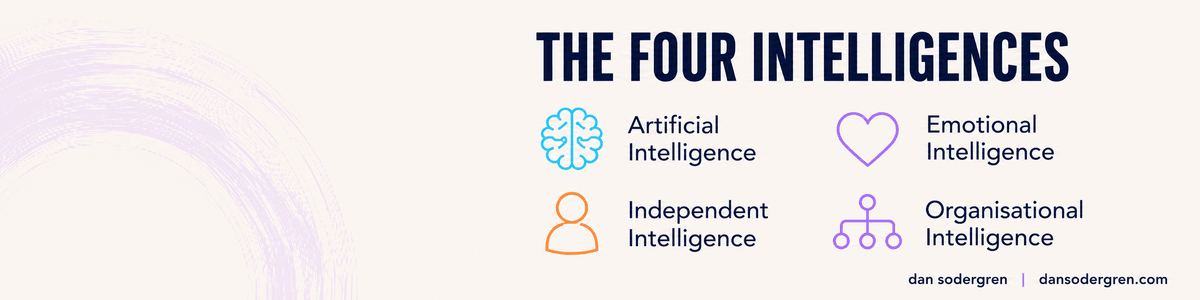
That is why the Fifth Industrial Revolution cannot be understood through Artificial Intelligence alone. It requires four different forms of intelligence: Artificial, Emotional, Independent and Organisational.
The Fifth Industrial Revolution Is a Human Revolution
There is a temptation to see each industrial revolution purely through its technology. We remember the steam engine, electricity, computers and the internet, but every technological revolution also changes human behaviour, power, leadership and society.
Artificial Intelligence will be no different.
According to the Office for National Statistics, AI adoption among UK businesses with ten or more employees has increased from approximately 12% in late 2023 to around 35% in 2026. However, businesses using AI still employ only 1.6 different AI technologies on average.
AI adoption is therefore broad, but still relatively shallow. Organisations have purchased licences and allowed access, but relatively few have redesigned their work, management practices or culture around what AI can now do.
Google’s AI and Economy ATLAS research identified a similar pattern. The study analysed 15 million anonymised interactions with Google’s AI products and found AI appearing across 68% of occupations representing approximately 90% of US employment. Within a typical job, however, AI touched only around 21% of tasks.
AI is already almost everywhere, but it has not yet been deeply integrated into most work. The challenge is no longer gaining access to the technology. It is learning how to use it intelligently, responsibly and humanely.
Artificial Intelligence: Managing the Automated Intern
I often describe AI systems as “automated interns” because it gives leaders and employees a practical way to understand them.
An automated intern can be extraordinarily capable. It can process information quickly, work continuously and help people complete tasks that previously took hours or even days. Yet, like any inexperienced intern, it needs a clear brief, relevant context, defined boundaries and somebody capable of checking its work.
Too many organisations are currently giving people access to AI without providing these management conditions. They introduce the technology, offer a short demonstration and hope employees will discover something valuable.
Some will. Many will not.
Artificial Intelligence therefore requires a new management capability: the allocation of work between humans and machines. Leaders must decide which tasks should remain human, which can be delegated to AI and which will produce the best results through collaboration.
They must also decide who remains accountable when something goes wrong. An AI system can produce the work, but responsibility cannot simply disappear into the software.
Emotional Intelligence: Leading People Through Uncertainty
Artificial Intelligence changes what work can be done. Emotional Intelligence determines how people experience that change.
Employees are not simply wondering whether AI can make them more productive. Many are quietly asking whether it will make them less valuable, remove parts of their role or eventually replace them completely.
These concerns cannot be solved with another technology demonstration. They require empathy, trust and honest conversations.
Personio’s Workforce Pulse research found that only 36% of employees believe their employer provides adequate AI training or support, while 44% want more help. This gap between adoption and enablement creates uncertainty, resistance and hidden AI use.
Employees may begin using unapproved systems because the official tools are inadequate or because they do not feel safe discussing what they are doing. Managers may pretend to understand AI because admitting uncertainty feels professionally dangerous. Senior leaders may promise that AI is entirely about augmentation while privately discussing headcount reductions.
This is why Emotional Intelligence will become more valuable as Artificial Intelligence becomes more powerful. Leaders need the ability to recognise fear, listen properly, explain difficult choices and maintain trust when they do not have every answer.
Independent Intelligence: Protecting Human Judgement
Artificial Intelligence can generate convincing answers with remarkable speed. Unfortunately, those answers can also be incomplete, biased or entirely wrong.
That makes Independent Intelligence essential.
Independent Intelligence is the ability to think critically, question assumptions and resist accepting the first answer simply because it appears confident. It means checking sources, challenging conclusions and knowing when human experience matters more than machine-generated probability.
This does not apply only to employees checking AI output. It also means employees having the confidence to challenge how their organisation is introducing the technology.
The people closest to a task often understand its complexity better than the leaders deciding whether it should be automated. They know which exceptions occur, which relationships matter and which apparently inefficient steps protect customers or prevent mistakes.
Organisations that silence those people will automate processes they do not properly understand. Organisations that encourage employee voice can redesign work with the people who know it best.
Independent Intelligence is therefore not resistance to AI. It is what helps us use AI responsibly.
Organisational Intelligence: Turning AI Experiments Into Transformation
It is relatively easy to demonstrate an impressive AI tool. It is much harder to make that tool work reliably inside a real organisation.
Organisations contain policies, legacy systems, competing priorities, informal networks, risk controls and people with very different levels of confidence. An AI experiment can succeed brilliantly in isolation but fail completely when it meets the reality of everyday work.
Organisational Intelligence is understanding how change actually happens within these systems. It means knowing who must be involved, what might block progress, which incentives need to change and how an experiment becomes part of a reliable workflow.
This is where many AI projects currently fail. They focus on what the technology can do without properly considering how the organisation works.
The Microsoft 2026 Work Trend Index found that when managers actively modelled AI use, employee trust in agentic AI rose by 30 points. When managers created psychological safety around experimentation, employees reported up to 20 points higher AI readiness and value.
The technology did not change in those organisations. The management conditions did.
That is Organisational Intelligence in action.
Connecting the Four Intelligences With Employee Engagement
This connection between technology and organisational conditions is what I will be exploring with Jo Dodds on the Engage for Success Radio Podcast.
Jo and I recently recorded a conversation about leadership, Artificial Intelligence and what it means to manage humans alongside automated interns. It will be broadcast on Monday 31 August at 5:30pm BST.
What makes this conversation particularly valuable is the connection between my Four Intelligences and Engage for Success’s Four Enablers.
Strategic Narrative Requires Organisational Intelligence
People need to understand why AI is being introduced, where it can create value and what the organisation is trying to become. Without a credible strategic narrative, employees will create their own explanation, which may be far more frightening than the truth.
Organisational Intelligence helps leaders connect AI investment to the organisation’s history, purpose, people and future direction.
Engaging Managers Need Artificial and Emotional Intelligence
Managers need sufficient Artificial Intelligence to understand the systems they are asking people to use. They also need Emotional Intelligence to recognise how those systems affect confidence, identity, workload and trust.
A manager who understands the technology but cannot lead people through uncertainty will struggle. So will a compassionate manager who cannot explain what the technology actually does.
The future requires both.
Employee Voice Depends on Independent Intelligence
Employees must have permission to question AI output and help redesign the work around it. They should be able to highlight risks, challenge weak assumptions and suggest better ways for humans and machines to collaborate.
This requires Independent Intelligence from employees and enough leadership maturity to listen to them.
Organisational Integrity Requires Emotional and Organisational Intelligence
Leaders need to be honest about the consequences of AI, including its effect on roles, responsibilities and productivity. Employees will notice if an organisation’s stated values do not match its real behaviour.
Emotional Intelligence helps leaders communicate difficult truths. Organisational Intelligence helps ensure that policies, incentives and decisions support what those leaders have promised.
The Strategic Choice: Replace—or Retrain, Retain and Scale?
Organisations now face an important choice about how they use the productivity created by AI.
They can use it primarily to remove cost and reduce headcount. Alternatively, they can retrain people, retain their experience and use AI to make them more capable.
The Microsoft 2025 Work Trend Index found that while 33% of leaders were considering headcount reductions, 78% were considering recruiting for new AI-related roles. Meanwhile, 83% believed AI would allow employees to take on more complex and strategic work earlier in their careers.
This suggests that the future is not predetermined. Technology creates possibilities, but leaders decide which possibility to pursue.
My preferred model is to retrain, retain and scale. This means teaching people to work effectively with AI, keeping the experience and organisational knowledge they already possess, and then using technology to increase what those people can achieve.
Not every role will remain unchanged. However, there is a profound difference between redesigning work with employees and imposing technology upon them.
Leadership in the Fifth Industrial Revolution
The defining leadership question of the next decade will not simply be whether an organisation uses AI. It will be whether that organisation can combine Artificial Intelligence with the other forms of intelligence required to use it well.
Artificial Intelligence provides capability. Emotional Intelligence builds trust. Independent Intelligence protects judgement, while Organisational Intelligence turns experimentation into genuine transformation.
Leaders who develop all four will be better equipped to manage people, automated interns and AI agents as part of the same workforce. Those who focus only on the technology may acquire powerful systems without creating an organisation capable of benefiting from them.
The future of work is not a contest between humans and machines. It is an opportunity to combine the best of both—but that opportunity will depend on the intelligence of the people leading the transition.
Listen to the Engage for Success Radio Podcast
Join Jo Dodds and me as we explore why we may be the last generation to manage only humans.
Monday 31 August 2026
5:30pm BST
You can also read my main article, We Are the Last Generation to Manage Only Humans, or learn more about my work as an AI and future-of-work keynote speaker.

About Dan Sodergren
Dan Sodergren is an author, AI transformation strategist, technology expert and keynote speaker specialising in Artificial Intelligence, the future of work and the Fifth Industrial Revolution.
He helps leaders and organisations understand how people, technology and intelligent systems can work together to create better businesses and a more human future of work.
Explore Dan’s AI keynote speaking, his approach to AI leadership training and his work on The Fifth Industrial Revolution.